Sunday, June 18, 2006

Titillating hexes

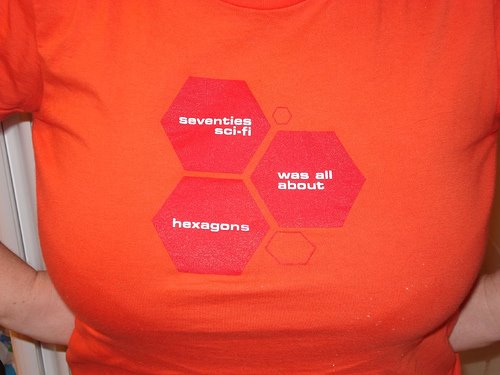
I've been using hex post-its for a while, and think they're fantastic. I was therefore very amused to find my partner had bought this T-shirt.

Another interesting observation I've made is that IT people don't seem to cluster hexes very well. They sort of overlap them and get them all wonky. Maybe they're just so use to putting things into rows and columns that they find it hard. Other people (scientists, managers etc) seem to do it with no problems.

Also amusing is that when I use the word 'tesselate' to explain why we use hexes, most non IT people find it very titillating, and snigger things like "I don't actually think it's appropriate to tesselate in public...". IT people however are totally familiar with the term and don't find it funny at all.

Visualcomplexity

This site is a collection of links to projects which visualise complex networks in some way:
http://www.visualcomplexity.com/vc/

The creator of the site spoke at MeshForum.

The one I like the best is 'We Feel Fine'
It extracts sentences from blogs that are likely to express emotion, e.g "I feel ...", "I'm feeling ..." to create kind of a dynamic mood map of the planet.

Thursday, June 01, 2006

Knowledge based on what?

This week we had a very interesting NZ Knowledge Management Network lunch in Christchurch. Mark English from Hindin Communications presented on his experience implementing 'knowledge bases' primarily for large public sector clients.

This approach stirred up a lot of discussion. Many people in the room came from a more 'organic' view of KM, and had a good understanding of the importance of narrative and experiential knowledge in organisations. What the speaker was advocating was a very structured, organised repository of knowledge, so that people could consistently give the 'right' answer. There was a lot of resistance to this until it became clear, through his patient explanations and examples, that there were contexts where this made absolute sense.

In the public sector, there are a lot of government departments and services that do have to give the right answer. The answers are based on policies, which are based on laws. These are things like 'where can I pay my rates?', 'am I eligible for a student loan?', 'what are my rights as a tenant?'. While there is often still some room for interpretation, the answers are fairly well set. The job of a knowledge base in this context is to help customer service representatives to give people accurate information. The knowledge management problem is not one of sense making in complexity, or expertise location, it is getting the right answer, to the right place, at the right time.

While we might be far more fascinated in the less tangible, more intellectually complex aspects of organisation culture and experiential knowledge in our KM programmes, I think there's a real place for better management of this sort of very structured knowledge.

Some of the answers the speaker had to questions raised further reinforced this for me. It wasn't an 'instead of' it was an 'as well as'. Sometimes the answers to questions were "ask this expert". It was just as valid for a system to connect people to people, where the answer couldn't easily be codified. They also had commenting and feedback mechanisms so that people using the information could identify where the rules or facts no longer seemed useful or accurate.

I think it's useful to see KM solutions and strategies as needing to encompass the whole spectrum of knowledge in organisations. If we get too caught up with the tacit, we'll miss real opportunities to add value in the explicit.
Monday, February 20, 2006

Giving up on internal search

I've completely given up on using internal search features of NZ public sector web sites (well, actually all web sites really). I've recently discovered the 'Search this site' button in the Google bar for Firefox. You can of course just use the site: modifier, but the button makes it one step easier. I consistently get much better results using Google than I do the search features on individual web sites. Often they won't turn up anything for a particular query, whereas Google will have exactly what I want right at the top of the list.

I can't help but think that Google has some options in terms of exploring alternate business models for exploiting this advantage they have. Corporates are unlikely to tolerate ads in the search results from their own site, but having some method of paying Google to make it fully transparent that Google is driving the search on a particular site might be attractive.

Spatial memory vs linguistic memory

My colleague Dan is about to launch a new version of his software. They've replaced their existing files and folders system with a tag based one. That's gotten me thinking further about the benefits of taxonomies vs folksonomies. The thing folksonomies lack is the ability to use our spatial memories. With a taxonomy, represented by a navigation tree I can remember physically 'where' I put something. It's up near the 'top' of the tree, and about four folders to the 'right', and about 'halfway down' the list of files. Of course this spatial distinction is arbitrary, the computer could display those folders many different ways depending on sort order etc. Most of the time though, we leave the tree displaying a particular way. With folksonomies there's no 'where'. Everythings in this kind of void, addressable through search and tags. It relies solely on our ability to remember words, to remember what we called something, rather than where we put it. Don't get me wrong, I love folksonomies, and am an avid user of Flickr, del.icio.us, openomy and other tag based sites. Maybe position in a tag cloud might help us use spatial memory to achieve similar results? I'm intrigued to see how easy/hard it will be for people to shift to folksonomy style approaches. I wonder if people who rely heavily on their spatial memories will find it harder than those who are more linguistically oriented.

Wednesday, February 01, 2006

The vibe of the thing

For almost 10 years now I've had my own browser start page. Having always worked with, rather than for, large corporates I've never been forced to have a bland company Intranet as my start page. I am, earlier in my career, guilty of architecting and project managing large (perhaps bland) Intranets, however in my defence I always argued strongly for introducing personalisation, even before there were portal technologies to make it easy.

The first versions of my browser start page were just static HTML files, populated with links to sites I used to visit often. I then moved to a content management system that allowed wysywig editing of this. When Google launched their personalised page service last year I started using this. Being able to have the blogs I read feed into portlets was the killer functionality for me. I wanted more though, being an early adopter of Web 2.0 services like del.icio.us and Flickr I thought it'd be great to be able to integrate those. Google hasn't done that yet, but there's a new service called Netvibes which does. It's a fully customisable start page, into which you can feed blogs, Flickr photos, your del.icio.us bookmarks and a whole host of other things. It feels like Portals have actually come of age, when all they are is a single aggregator page for your own purely self selected content...

Tuesday, January 31, 2006

The Art of Demotivation

Organizational Storytelling is becoming a big movement. So much so that it's been satirised wonderfully by Despair Inc.. There's a link to an audio podcast and a video podcast at the bottom of the page.

Sunday, January 15, 2006

LinkedIn tipping point?

Just back from holiday and I'm getting lots of requests from people I know to join LinkedIn. I've been a member of various web based social network systems for a couple of years, but have only been reactive. That is, if someone asks me to join I do, but I don't try to 'build' my online network (I do put lots of effort into my offline social network). I've always been intrigued by the potential for computers to facilitate social networks, but I've been leary of the simplistic approaches taken so far. Then there's the truism that whenever a human system is made explicit it can be gamed.

I'm curious as to what's happened with LinkedIn that's suddenly made it more popular. It will be interesting to see whether this surge dies off, or continues.

What I really want though, is for it to be integrated into the automatic checkin kiosks at the airport. I want them to say "this person in your network is also on this plane, would you like to sit beside them?".

Monday, December 19, 2005

Social Physics

I listened to this podcast this morning. I'm not sure I agree with the value of attempting to codify trust in electronic social networks, however what he's talking about seems a huge leap ahead from Linked In, Friendster and the like. His work seems very grounded in an understanding of complexity. It seems to me to have some real potential in terms of digital identities, and what he's calling the emerging 'social web'. There's more info at http://www.socialphysics.org/

Thursday, December 08, 2005

Science in the web age

The science journal Nature has just published a set of articles on the use of blogs, wikis, and web services in sharing information in the research community. This one I found particularly interesting as it goes into some of the reasons why uptake in the science community has so far been very low. The usual suspects of course - fear it won't be seen as formal or appropriate enough by peers, fears of research ideas being taken by others etc. This does seem to be changing however, and appears to be leading to bigger audiences for the early adopters, and more cross disciplinary exposure of ideas.

Thursday, December 01, 2005

KMAP 2005

Earlier this week I went to the KM Asia Pacific conference, held at Victoria University of Wellington, in New Zealand. The theme of the conference was "Building a Knowledge Society: Linking Government, Business, Academia and the Community". As such there was a lot of talk about using KM methods in the policy and e-government arena. I'm starting to get fascinated by the potential for cross sector KM. In my work in the environmental research and management sector in NZ I think we're starting to achieve some gains, but we're still very much at the first generation of KM, in terms of connecting up data and information systems. Highlights of the conference were:

  • Jane Fountain's keynote "Can Government be a Catalyst for the Knowledge Society".
  • The workshop on "Bridging the Policy-Technology Divide: Developments in NZ Public Sector Information Management" organised by SPEAR. This was a superb example of 'unconferencing' a highly interactive workshop session in the midst of a very 'lecture' style conference.
  • Meeting David Rooney, a truly lovely and insightful man, and hearing his theories on Wisdom Management. I don't yet quite buy his distinction between wisdom and knowledge, but it's a very useful debate to be having I think.
  • Dave Snowden's closing keynote on "Co-Evolutionary Approaches to Inter-Disciplinary and Cross Silo Knowledge Creation", in which he roundly challenged the hypothesis driven methods of academics, practioners and managers. His argument was that the current process of industry 'experimenting' and then academics studying those experiments to elicit 'best practice' is just too slow in today's world. He advocated a proactive rather than retrospective approach to research in which research co-evolves with practice, and is done in real world contexts, in organisations, rather than as external observation.

Monday, November 07, 2005

Evangelists tell stories

Last week I was asked to present at the World Usability Day events in Christchurch. The topic was Usability: Evangelising for Change. Usability isn't my field, so I wasn't quite sure what I was going to say. I have in my career however, been driven to evangelise many new approaches and methods. This includes web design (in the mid 90s), Intranets, Knowledge Management, Change Management, dataset federation, Grid computing, the list goes on. As I put together the presentation, I realised that almost every means for evangelising that I had used over the years included a strong narrative component.

In the presentation used Steve Denning's World Bank story as an example (using a story to promote the use of story...). In thinking about whether diagrams (e.g. consultant's 2x2 matrices) had ever worked for me, as they hadn't for Steve so he relied on story, I realised that where these had been successful they had used narrative elements. Effectively we had found metaphors that resonated with the client, (e.g. an ecological metaphor for knowledge flow at an environmental research institute) and used these in diagrams to represent a KM strategy.

Another method that works well is centred around the "you can't be a prophet in your own land" truism. This involves getting your customers to tell their success stories. If we look back to many successful prophets and evangelists, they conveyed their new and often controversial ideas through parables and fables.

Stories, stories, everywhere. Here are the presentation slides.

Tuesday, November 01, 2005

Feral Robot Dogs

It was a sunny day at the Mission Bay Landfill site in San Diego. Over the normally tranquil, sun baked ground came rolling an army of dogs, sniffing here, sniffing there. Following the dogs came an unusual collection of students, local politicians, Environmental Health specialists and journalists. They watched the dogs as they sniffed out environmental toxin emissions, following scent vectors across the site containing over fifty years of industrial waste dumping.

But these weren't just any dogs. They were feral robot dogs. They started their lives as inane children's toys, but through mutations caused by inspired hardware and software hacking conducted by students they have been transformed into tools for mediagenic activist sense making.

Putting aside a passing interest in the emerging hardware hacking movement, I find this fascinating. Fascinating in terms of participative sense making, rather than any techno wizardry. These dogs have cameras mounted in their rears, rather than their fronts (where their toxic sensing 'noses' are). The cameras are in their rears so they can film the people following them. These aren't so much scientific devices as a way of enabling lay people to make sense of the invisible threats in their local environment. People follow the dogs, observe their behaviour, talk to each other, have conversations about the significance of what the dogs do, interact with people they normally wouldn't have, and make collective sense of the problem facing them. The conversations and people's actions are filmed for further discussion and sense making later. This might not be as 'precise' as a scientist taking an industrial strength 'sniffer', analysing the data, writing a paper, and presenting at a conference, but it's a damn sight more real to those who participate. As such, is seems just possible that it might spur more action, make more of a difference.

If we let people create tools that enable them to make collective sense of their surroundings (whether in a landfill or a corporate organisation), are they more likely to take effective action than if they receive advice from an outside expert?

A pod cast on the project is available at IT Conversations. More info on the project at http://xdesign.ucsd.edu/feralrobots/

Wednesday, September 21, 2005

Collective excellence vs individual excellence

Andrew Rixon's recent post on Anecdote regarding a book called 'Improv Wisdom' has got me thinking about about collective excellence vs individual excellence. I'm seeing lots of trends moving away from considering that intellect and productivity come from the individual to these coming from groups. Dave Snowden's 'From Atomism to Networks in Social Systems', The Wisdom of Crowds, the increasing profile of techniques like Open Space Technology, World Cafe, Dotmocracy are all favouring collective wisdom. If you start translating that into excellence and productivity, the four maxims from Improv Wisdom begin to make sense:

  • "Say Yes"
  • "Be Average"
  • "Make Mistakes, Please"
  • "Take Care of Each Other"

These might be considered suboptimal behaviour in many organisations. Where the culture encourages individual excellence, and aggregates that up into what it believes to be optimal organisational performance these would be seen as signs of weakness. It seems possible thought that they might actually optimise overall organisational excellence in many cases. The last three especially perhaps add enough slack/redundancy in the system to enable more knowledge sharing, synergy, and the emergence of collective innovation. It's well understood in designing networks that having a degree of redundancy (introducing cycles into the network, which ensures that nodes are connected by more than one path) both protects against failure and ensures more optimised system wide results in the long run. Is it possible that the above maxims might produce a similar effect in the complex social systems in the organisations we work in?

Monday, September 05, 2005

Thinking alike, separately

Curiously Shawn just posted this: Anecdote: Collective meaning and group decision making. Given its similarity to my recent post on collective decision making I asked him if he'd seen my post. He hadn't but concluded that when interesting books like Wisdom of Crowds appear it starts people thinking in a certain direction. I'm sure this happens with many ideas. It seems a related phenomenon to 'aggregated, non-interactive' decision making, but instead of a decision it's the spontaneous distributed emergence of an idea or distinction.

Wednesday, August 24, 2005

Collective decision making - To interact or not

Another take on collective sense making/decision making I've been thinking about is the difference between methods that do or don't use interaction in the process. Open Space Technology and Cynefin methods for example use group deliberative processes where people engage with each other to make decisions. Even conventional facilitated consensus approaches to strategy
require that people have to engage with each other in some way to come up with a collective decision. James Surowiecki in The Wisdom of Crowds suggests however that some highly effective predictive decisions can be taken by the aggregation of individuals' decisions with little or no interaction in the process. For example he cites the case where participants in the stock market collectively determined which of the potential four companies was responsible for the defect that caused the Colombia space shuttle disaster, a full six months before the official investigation concluded the same. It'll be interesting to see how methods emerge for using this type of 'aggregated, non-interactive' mass decision making in organisations.

Monday, August 22, 2005

Folksonomy - How I Learned to Stop Worrying and Love the Mess

Folksonomy - How I Learned to Stop Worrying and Love the Mess. I found this podcast fascinating. It's a panel interview with Joshua Schachter (del.icio.us), Stewart Butterfield (Flickr), Jimmy Wales (Wikipedia) and Clay Shirky on different approaches to tags and the loose, user defined ontologies they create. The key distinction for me was the different purpose tagging has in each service. In del.icio.us people are tagging other people's things (URLs) for their own benefit (so they can find them more easily than with conventional bookmarks). The 'social software' benefit is effectively just a handy side effect. With Flickr people tag their own things for their own, and other people's benefit. With Wikipedia, a group of people tag to categorise content purely for other people's benefit. This has interesting implications in terms of the way things are tagged, and whether tags can be useful combined across a range of different services.

Sunday, August 14, 2005

Purple on the nose

I attended the afternoon of a full day session the Ministry of Education put on for Etienne Wenger in Wellington. Etienne is a world renowed expert on Communities of Practice. He covered some practical aspects of communities of practice in the morning, and more theoretical content in the afternoon. Those who know me will know it's not often I wish a speaker would be a bit more tangible...

Etienne talked about knowledge being socially constructed, that it was more about your identity as a knower in a community than about storing stuff in your head. He used the example of 'purple on the nose' a phrase used by a friend of his who was a wine connoisseur. Etienne could not 'know' this in that he didn't have the experience or competence to detect it in the glass of wine. Nor could he claim that it was in fact 'yellow on the shoulder' because he didn't have the status within the wine tasting community to make such a claim. The knowledge of 'purple on the nose' he said was a property of the wine tasting community, and knowing it was a socially negotiated act of membership in that community. Human practices, he said, create a universe of knowledge of their own, which is inaccessible unless you join that practice. The path of learning is more about managing your trajectory through a community of knowers than it is about acquiring information.

Great stuff, but a bit like the bottle of red Etienne mentioned, it did make my head swim a bit trying to take it all in. I've often pondered the notion that even though knowledge is essentially 'brain based' (as distinct from information which is paper or electronically based) it is possible for organisations to 'know' things. Etienne solidified these ideas a bit further for me. I'm not sure I agree completely, but it does provide another useful lens through which to investigate the way knowledge works in groups, communities and organisations.

I also like the comments Derek Wenmouth makes about the session in his blog post on Boundary Workers.

Thursday, August 11, 2005

Ownership vs Resonance in Strategy

Buy in and ownership are often touted as essential in strategic planning and in ensuring planned strategic actions actually happen. I've always focused more on the process rather than the output (or document) in strategic planning. I've attempted to make strategy memorable, to boil it down to a few key guiding principles so that it continues to inform day to day action (without people having to re-read a long document every time they make a decision).

This has got me thinking about resonance. When a group of managers go away on a retreat for example and write a mission statement or vision they go through a myriad of discussions, arguments, story telling and thinking processes to end up with something that is, for them, richly embued with meaning. Then they bring it back and present it proudly to the organisation and wonder why people aren't all that excited by those carefully crafted words.

I think part of the answer has to do with ownership and involvement - if people haven't been involved in something they're less likely to be enthused about it. I also think there's more to it than that. Involvement in the process creates resonance. The words in a strategy, mission statement or vision are semantic hooks into a set of ideas, experiences and judgements they've had through the process. They become a shortcut to a set of cognitive patterns, or tacit knowledge, that reinforce and affect action.

A colleague I met with in Australia recently shared with me a story about a mission statement he'd recently developed with a community group he was a member of. He knew he would only get involvement from a small subset in a half day workshop, so he devised an activity where everybody wrote down three or four words that represented what the organisation meant for them. These were clustered and used as a basis for discussion in the workshop. This meant everyone participated, many saw their words in the final mission statement, and there were different degrees of resonance based on this graduated method of participation.

Tuesday, February 08, 2005

Knowledge Environments I've just published a review of the way physical environments can influence knowledge flow in organisations. This was based on a paper I wrote for Landcare Research looking at how they might better use the space in their new building in Auckland. The review contains summaries of a lot of the leading thinking in this area, especially that of Victoria Ward and the Space SIG on Knowledgeboard.com.