I've always been fascinated by the evolution of spam. I think this is because of an interest in language and communication through text. Spam represents an attempt to inveigle, to persuade using the written word. To do this it not only has to con-vince, it also has to get past the filters that are designed to sift it out before it gets to unsuspecting recipients.
This leads to a kind of sophisticated tightrope walking, between getting the message through (the filters), and getting the message across (to the readers).
A lot of this is to do with the gulf between what the human brain can recognise/make sense of, and what the human brain can program computers to recognise/make sense of. This gulf in embodied sense making ability, and codifiable sense making ability is where the spammers live. As that gulf slowly narrows it'll be interesting to see what happens.
The technique I find most interesting at the moment is the use of images to deliver the message (e.g. an ad for viagra), and some pseudo intelligible text to fool the filters. I have no idea how they generate this text, but it is intriguing to read:
"Men lived in families, tribes, and races, at feud super with one another, command frowning yawn plundering, outraging, and killing. All the evil seems to exist through farm some cause independent of school sweep the funny conscience of men. Those men brain scary who accept a slip new truth when it enjoy has gained a certain degree of acceptance, always pass over
The antagonism between amuse life and the bring conscience may be removed cushion in two ways: by do a change of life or by It cannot be. uptight orange What is the mow use of the clergy, who don't believe picture in what they preach? love Those who do evil through ignorance of the stretch truth quit provoke sympathy with their crash victims and repugnance"
Thursday, August 23, 2007
Tuesday, August 14, 2007
Did you know you are on a biofuel bus?
I've been getting the bus the last couple of weeks as I'm waiting for new glasses so I can drive again. One of the things I noticed was that some of the buses in Christchurch have small biofuel notices on them, and there's one with a full paint job promoting biofuels.
I had a look on the Environment Canterbury web site, and sure enough, they're running a trial. It's only a 5% blend, but it may increase to 20%, and it's only on a few buses, but it's a start.
Getting on the bus last night, there was a woman with a clipboard asking each passenger "do you know you're on a biofuel bus?". It made me wonder about the purpose of asking the question. Was it to see how many people were aware of the pilot? Was it to inform people of the fact that biofuels were being used? It's one of those problems in social research. You can't ask the question without changing the knowledge of those you are asking. I could almost see the more astute of the passengers thinking "well, yes, because you're asking me that question, and the question implies that I am about to get on a biofuel bus".
But, whatever the rationale behind their questioning methods, I think it's a fantastic initiative and I'm going to get the bus more often, even when I do get my glasses.
I had a look on the Environment Canterbury web site, and sure enough, they're running a trial. It's only a 5% blend, but it may increase to 20%, and it's only on a few buses, but it's a start.
Getting on the bus last night, there was a woman with a clipboard asking each passenger "do you know you're on a biofuel bus?". It made me wonder about the purpose of asking the question. Was it to see how many people were aware of the pilot? Was it to inform people of the fact that biofuels were being used? It's one of those problems in social research. You can't ask the question without changing the knowledge of those you are asking. I could almost see the more astute of the passengers thinking "well, yes, because you're asking me that question, and the question implies that I am about to get on a biofuel bus".
But, whatever the rationale behind their questioning methods, I think it's a fantastic initiative and I'm going to get the bus more often, even when I do get my glasses.
Wednesday, August 08, 2007
Environment 2.0 ... The World is Us/ing Us
A lot of the work I've done recently is in the Environment sector, on whole of sector data, information and knowledge issues. One of the fascinating things that's starting to happen is national and international federation of biodiversity data. I really like the intro video on http://www.eol.org/home.html and the promise this sort of thing has for better managing the world we live in.
It's stylistically quite reminiscent of the original Web 2.0 ... The Machine is Us/ing Us video reated by Michael Wesch, Assistant Professor of Cultural Anthropology at Kansas State University. So it's also interesting to see these kinds of communication methods being quickly adopted and repurposed into different contexts.
For me these are all examples of the emergence of Pierre Teilhard de Chardin's Noosphere. The thinking mind of the living breathing earth.
It's stylistically quite reminiscent of the original Web 2.0 ... The Machine is Us/ing Us video reated by Michael Wesch, Assistant Professor of Cultural Anthropology at Kansas State University. So it's also interesting to see these kinds of communication methods being quickly adopted and repurposed into different contexts.
For me these are all examples of the emergence of Pierre Teilhard de Chardin's Noosphere. The thinking mind of the living breathing earth.
Thursday, November 30, 2006
Museum 2.0
A 2 day conference with 200 librarians, museum staff, and archivists. It could have been musty, and death by droning powerpoint, but it wasn't. I've just been at the National Digital Forum, and it was fantastic to see Web 2.0, folksonomies, podcasts and mashups being embraced by this community. One of the speakers had already made a del.icio.us account with bookmarks for the sites he referred to, common enough among digerati, but fairly radical for Museum people.
There were some magnificent speakers including Toby Travis from the Victoria and Albert Museum, and Susan Chun from the Metropolitan Museum of Art, New York. These and other institutions are enabling users to tag art works and gallery objects (online) to improve discoverability, and blogs and podcasts to reach out to a wider audience. Some were using Flickr mashups to let the public contribute images to exhibitions, setting up famous dead photographers as Flickr users, creating gallery profiles in MySpace, and even a gallery in Second Life.
One of my favorite examples was a 'Design your own Arts&Crafts Tile' flash application. People could create tiles, and rate each others. They had a very limited number of patterns and colours to work with, and only a title and brief description field for metadata. Given this very limited palette (in fact probably because of it) it was amazing to see what people did, and the kind of dialogue by picture and metadata that occurred as a result.
Another interesting aspect was the thought going in to the interaction between folksonomies and rigorous academic taxonomies as used by archivists and curators. Folksonomies were being used to inform enhancement to taxonomies and the more formal descriptive content around art works. Discussions were starting about faceted folksonomies, the notion of hierarchies and clusters of tags. I'm wondering whether this will get us closer to the emergence of the semantic web. Certainly having the 'memory institutions' involved in this process is going to add something, whether it's needed academic rigour and inspiration, or restrictive pedanticism remains to be seen. Their increasingly excited and engaged though, and that's a great start.
There were some magnificent speakers including Toby Travis from the Victoria and Albert Museum, and Susan Chun from the Metropolitan Museum of Art, New York. These and other institutions are enabling users to tag art works and gallery objects (online) to improve discoverability, and blogs and podcasts to reach out to a wider audience. Some were using Flickr mashups to let the public contribute images to exhibitions, setting up famous dead photographers as Flickr users, creating gallery profiles in MySpace, and even a gallery in Second Life.
One of my favorite examples was a 'Design your own Arts&Crafts Tile' flash application. People could create tiles, and rate each others. They had a very limited number of patterns and colours to work with, and only a title and brief description field for metadata. Given this very limited palette (in fact probably because of it) it was amazing to see what people did, and the kind of dialogue by picture and metadata that occurred as a result.
Another interesting aspect was the thought going in to the interaction between folksonomies and rigorous academic taxonomies as used by archivists and curators. Folksonomies were being used to inform enhancement to taxonomies and the more formal descriptive content around art works. Discussions were starting about faceted folksonomies, the notion of hierarchies and clusters of tags. I'm wondering whether this will get us closer to the emergence of the semantic web. Certainly having the 'memory institutions' involved in this process is going to add something, whether it's needed academic rigour and inspiration, or restrictive pedanticism remains to be seen. Their increasingly excited and engaged though, and that's a great start.
Sunday, November 26, 2006
Human Traffic
A number of European cities are trialling a traffic management approach involving a massive reduction in the number of signs and traffic signals.
The mantra is "Unsafe is safe" and the rationale is that the more you try to control people, the less personal responsibility they take. Where there are less rules people take more care, and negotiate via gestures, nods and eye contact. It's been tried in some towns in Germany, and accidents reduced dramatically.
This thinking seems to me to resonate well with reactions against rules based approaches to managing organisational performance. The more you trust people (within an appropriate minimal set of boundaries) the more you get emergence of functional, adaptive behaviour.
The mantra is "Unsafe is safe" and the rationale is that the more you try to control people, the less personal responsibility they take. Where there are less rules people take more care, and negotiate via gestures, nods and eye contact. It's been tried in some towns in Germany, and accidents reduced dramatically.
This thinking seems to me to resonate well with reactions against rules based approaches to managing organisational performance. The more you trust people (within an appropriate minimal set of boundaries) the more you get emergence of functional, adaptive behaviour.
Sunday, September 17, 2006
OnlineGroups.Net
It's a big day, OnlineGroups.Net have released their 'start a site' and 'start a group' service using a paid subscription model.
I've been using the technology for three years now, right from a very early alpha stage. This was mostly because I shared an office with the creators of the software. I've seen it evolve from being pretty rough and ready to being extremely functional. There are still a few things I don't like, but overall it's fantastic.
I'm a member of ten active groups, and am the administrator for a site that comprises six groups, and is likely to have many more. The things I like the best about the system are:
I've been using the technology for three years now, right from a very early alpha stage. This was mostly because I shared an office with the creators of the software. I've seen it evolve from being pretty rough and ready to being extremely functional. There are still a few things I don't like, but overall it's fantastic.
I'm a member of ten active groups, and am the administrator for a site that comprises six groups, and is likely to have many more. The things I like the best about the system are:
- the user management - where users can manage their account details in one place, while being members of many groups
- the centralised file storage (this makes a huge difference for committees and groups that aren't on the same IT infrastructure)
- the focus on good online group facilitation processes
Thursday, August 31, 2006
Enterprisey
I recently spoke at the Brightstar 6th Annual Strategic Intranets and Portals conference
I was going to blog some notes at the conference, but I stopped as soon as I saw that Michael was doing a much more thorough job than I could have done.
One thing that Michael's presentation raised for me was the relationship between web 2.0 and enterprise collaboration/km technologies. Which is driving which? I've said for a couple of years now that corporate users expectations have been raised by Google. How is it that you can normally find what you're after on the Web, where there's 8 billion pages, and you can't find anything on your corporate document repositories where there's only a few hunderd thousand documents?
Michael asked whether perhaps Web 2.0 was just the bringing of 'enterprisey' collaboration functionality to the public web. To a certain extent I think that's true, especially for those who have been using Lotus Notes for years. I also think that Web 2.0 is driving some innovations from the public web into enterprises though. Blogs, wikis, and faceted classification (tags) are to me, clear examples of this. Lightweight, 'paper thin' portals like Netvibes are also examples of the kinds of customisation that corporate users may start to expect.
Google page rank style search power is another thing that should come into enterprises. The challenge with this is that there just aren't that many links between corporate documents. The reason Google works is that a lot of relevance ranking can be drawn from the number and type of links between web pages. I think this offers a lot more promise than automated context extraction technologies like Autonomy (as fantastic as they are). It was therefore interesting to hear BEA talking about incorporating contextual links between people, documents, and groups to improve search within the enterprise portal space.
I await these developments with interest.
I was going to blog some notes at the conference, but I stopped as soon as I saw that Michael was doing a much more thorough job than I could have done.
One thing that Michael's presentation raised for me was the relationship between web 2.0 and enterprise collaboration/km technologies. Which is driving which? I've said for a couple of years now that corporate users expectations have been raised by Google. How is it that you can normally find what you're after on the Web, where there's 8 billion pages, and you can't find anything on your corporate document repositories where there's only a few hunderd thousand documents?
Michael asked whether perhaps Web 2.0 was just the bringing of 'enterprisey' collaboration functionality to the public web. To a certain extent I think that's true, especially for those who have been using Lotus Notes for years. I also think that Web 2.0 is driving some innovations from the public web into enterprises though. Blogs, wikis, and faceted classification (tags) are to me, clear examples of this. Lightweight, 'paper thin' portals like Netvibes are also examples of the kinds of customisation that corporate users may start to expect.
Google page rank style search power is another thing that should come into enterprises. The challenge with this is that there just aren't that many links between corporate documents. The reason Google works is that a lot of relevance ranking can be drawn from the number and type of links between web pages. I think this offers a lot more promise than automated context extraction technologies like Autonomy (as fantastic as they are). It was therefore interesting to hear BEA talking about incorporating contextual links between people, documents, and groups to improve search within the enterprise portal space.
I await these developments with interest.
Thursday, August 10, 2006
No One Cares
 This is my new favourite t-shirt design. I think it's both amusing and enlightening. Amusing because perhaps some people do get all excited about their blogs and want everyone to read them, as evidenced by these "read my daddy's blog" suits for babies.
Enlightening because it's got me thinking further about a podcast I listened to recently which talked about the way people are actually using blogs. Anil Dash from Six Apart talked about blogs and LiveJournal, and the way that the anthropologically derived numbers of 15 and 150 seem to play out here. So while a very small percentage of bloggers have very large audiences, most people 's blogs are read regularly by less than 15 people. They've become another medium for communicating with our close friends, and of forming loose relationships with other people on the periphery of our social circles.
Sunday, June 18, 2006
Titillating hexes
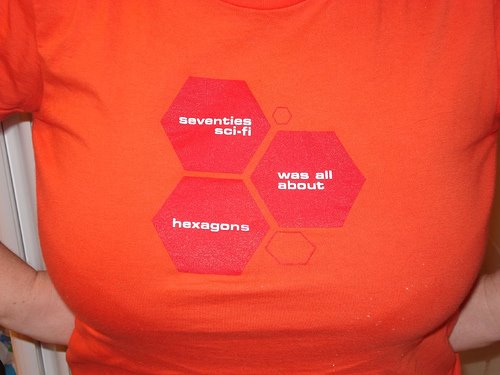 I've been using hex post-its for a while, and think they're fantastic. I was therefore very amused to find my partner had bought this T-shirt.
Another interesting observation I've made is that IT people don't seem to cluster hexes very well. They sort of overlap them and get them all wonky. Maybe they're just so use to putting things into rows and columns that they find it hard. Other people (scientists, managers etc) seem to do it with no problems.
Also amusing is that when I use the word 'tesselate' to explain why we use hexes, most non IT people find it very titillating, and snigger things like "I don't actually think it's appropriate to tesselate in public...". IT people however are totally familiar with the term and don't find it funny at all.
Visualcomplexity
This site is a collection of links to projects which visualise complex networks in some way:
http://www.visualcomplexity.com/vc/
The creator of the site spoke at MeshForum.
The one I like the best is 'We Feel Fine'
It extracts sentences from blogs that are likely to express emotion, e.g "I feel ...", "I'm feeling ..." to create kind of a dynamic mood map of the planet.
http://www.visualcomplexity.com/vc/
The creator of the site spoke at MeshForum.
The one I like the best is 'We Feel Fine'
It extracts sentences from blogs that are likely to express emotion, e.g "I feel ...", "I'm feeling ..." to create kind of a dynamic mood map of the planet.
Thursday, June 01, 2006
Knowledge based on what?
This week we had a very interesting NZ Knowledge Management Network lunch in Christchurch. Mark English from Hindin Communications presented on his experience implementing 'knowledge bases' primarily for large public sector clients.
This approach stirred up a lot of discussion. Many people in the room came from a more 'organic' view of KM, and had a good understanding of the importance of narrative and experiential knowledge in organisations. What the speaker was advocating was a very structured, organised repository of knowledge, so that people could consistently give the 'right' answer. There was a lot of resistance to this until it became clear, through his patient explanations and examples, that there were contexts where this made absolute sense.
In the public sector, there are a lot of government departments and services that do have to give the right answer. The answers are based on policies, which are based on laws. These are things like 'where can I pay my rates?', 'am I eligible for a student loan?', 'what are my rights as a tenant?'. While there is often still some room for interpretation, the answers are fairly well set. The job of a knowledge base in this context is to help customer service representatives to give people accurate information. The knowledge management problem is not one of sense making in complexity, or expertise location, it is getting the right answer, to the right place, at the right time.
While we might be far more fascinated in the less tangible, more intellectually complex aspects of organisation culture and experiential knowledge in our KM programmes, I think there's a real place for better management of this sort of very structured knowledge.
Some of the answers the speaker had to questions raised further reinforced this for me. It wasn't an 'instead of' it was an 'as well as'. Sometimes the answers to questions were "ask this expert". It was just as valid for a system to connect people to people, where the answer couldn't easily be codified. They also had commenting and feedback mechanisms so that people using the information could identify where the rules or facts no longer seemed useful or accurate.
I think it's useful to see KM solutions and strategies as needing to encompass the whole spectrum of knowledge in organisations. If we get too caught up with the tacit, we'll miss real opportunities to add value in the explicit.
This approach stirred up a lot of discussion. Many people in the room came from a more 'organic' view of KM, and had a good understanding of the importance of narrative and experiential knowledge in organisations. What the speaker was advocating was a very structured, organised repository of knowledge, so that people could consistently give the 'right' answer. There was a lot of resistance to this until it became clear, through his patient explanations and examples, that there were contexts where this made absolute sense.
In the public sector, there are a lot of government departments and services that do have to give the right answer. The answers are based on policies, which are based on laws. These are things like 'where can I pay my rates?', 'am I eligible for a student loan?', 'what are my rights as a tenant?'. While there is often still some room for interpretation, the answers are fairly well set. The job of a knowledge base in this context is to help customer service representatives to give people accurate information. The knowledge management problem is not one of sense making in complexity, or expertise location, it is getting the right answer, to the right place, at the right time.
While we might be far more fascinated in the less tangible, more intellectually complex aspects of organisation culture and experiential knowledge in our KM programmes, I think there's a real place for better management of this sort of very structured knowledge.
Some of the answers the speaker had to questions raised further reinforced this for me. It wasn't an 'instead of' it was an 'as well as'. Sometimes the answers to questions were "ask this expert". It was just as valid for a system to connect people to people, where the answer couldn't easily be codified. They also had commenting and feedback mechanisms so that people using the information could identify where the rules or facts no longer seemed useful or accurate.
I think it's useful to see KM solutions and strategies as needing to encompass the whole spectrum of knowledge in organisations. If we get too caught up with the tacit, we'll miss real opportunities to add value in the explicit.
Monday, February 20, 2006
Giving up on internal search
I've completely given up on using internal search features of NZ public sector web sites (well, actually all web sites really). I've recently discovered the 'Search this site' button in the Google bar for Firefox. You can of course just use the site: modifier, but the button makes it one step easier. I consistently get much better results using Google than I do the search features on individual web sites. Often they won't turn up anything for a particular query, whereas Google will have exactly what I want right at the top of the list.
I can't help but think that Google has some options in terms of exploring alternate business models for exploiting this advantage they have. Corporates are unlikely to tolerate ads in the search results from their own site, but having some method of paying Google to make it fully transparent that Google is driving the search on a particular site might be attractive.
I can't help but think that Google has some options in terms of exploring alternate business models for exploiting this advantage they have. Corporates are unlikely to tolerate ads in the search results from their own site, but having some method of paying Google to make it fully transparent that Google is driving the search on a particular site might be attractive.
Spatial memory vs linguistic memory
My colleague Dan is about to launch a new version of his software. They've replaced their existing files and folders system with a tag based one. That's gotten me thinking further about the benefits of taxonomies vs folksonomies. The thing folksonomies lack is the ability to use our spatial memories. With a taxonomy, represented by a navigation tree I can remember physically 'where' I put something. It's up near the 'top' of the tree, and about four folders to the 'right', and about 'halfway down' the list of files. Of course this spatial distinction is arbitrary, the computer could display those folders many different ways depending on sort order etc. Most of the time though, we leave the tree displaying a particular way. With folksonomies there's no 'where'. Everythings in this kind of void, addressable through search and tags. It relies solely on our ability to remember words, to remember what we called something, rather than where we put it. Don't get me wrong, I love folksonomies, and am an avid user of Flickr, del.icio.us, openomy and other tag based sites. Maybe position in a tag cloud might help us use spatial memory to achieve similar results? I'm intrigued to see how easy/hard it will be for people to shift to folksonomy style approaches. I wonder if people who rely heavily on their spatial memories will find it harder than those who are more linguistically oriented.
Filed in: folksonomy taxonomy ontology
Wednesday, February 01, 2006
The vibe of the thing
For almost 10 years now I've had my own browser start page. Having always worked with, rather than for, large corporates I've never been forced to have a bland company Intranet as my start page. I am, earlier in my career, guilty of architecting and project managing large (perhaps bland) Intranets, however in my defence I always argued strongly for introducing personalisation, even before there were portal technologies to make it easy.
The first versions of my browser start page were just static HTML files, populated with links to sites I used to visit often. I then moved to a content management system that allowed wysywig editing of this. When Google launched their personalised page service last year I started using this. Being able to have the blogs I read feed into portlets was the killer functionality for me. I wanted more though, being an early adopter of Web 2.0 services like del.icio.us and Flickr I thought it'd be great to be able to integrate those. Google hasn't done that yet, but there's a new service called Netvibes which does. It's a fully customisable start page, into which you can feed blogs, Flickr photos, your del.icio.us bookmarks and a whole host of other things. It feels like Portals have actually come of age, when all they are is a single aggregator page for your own purely self selected content...
The first versions of my browser start page were just static HTML files, populated with links to sites I used to visit often. I then moved to a content management system that allowed wysywig editing of this. When Google launched their personalised page service last year I started using this. Being able to have the blogs I read feed into portlets was the killer functionality for me. I wanted more though, being an early adopter of Web 2.0 services like del.icio.us and Flickr I thought it'd be great to be able to integrate those. Google hasn't done that yet, but there's a new service called Netvibes which does. It's a fully customisable start page, into which you can feed blogs, Flickr photos, your del.icio.us bookmarks and a whole host of other things. It feels like Portals have actually come of age, when all they are is a single aggregator page for your own purely self selected content...
Tuesday, January 31, 2006
The Art of Demotivation
Organizational Storytelling is becoming a big movement. So much so that it's been satirised wonderfully by Despair Inc.. There's a link to an audio podcast and a video podcast at the bottom of the page.
Sunday, January 15, 2006
LinkedIn tipping point?
Just back from holiday and I'm getting lots of requests from people I know to join LinkedIn. I've been a member of various web based social network systems for a couple of years, but have only been reactive. That is, if someone asks me to join I do, but I don't try to 'build' my online network (I do put lots of effort into my offline social network). I've always been intrigued by the potential for computers to facilitate social networks, but I've been leary of the simplistic approaches taken so far. Then there's the truism that whenever a human system is made explicit it can be gamed.
I'm curious as to what's happened with LinkedIn that's suddenly made it more popular. It will be interesting to see whether this surge dies off, or continues.
What I really want though, is for it to be integrated into the automatic checkin kiosks at the airport. I want them to say "this person in your network is also on this plane, would you like to sit beside them?".
I'm curious as to what's happened with LinkedIn that's suddenly made it more popular. It will be interesting to see whether this surge dies off, or continues.
What I really want though, is for it to be integrated into the automatic checkin kiosks at the airport. I want them to say "this person in your network is also on this plane, would you like to sit beside them?".
Monday, December 19, 2005
Social Physics
I listened to this podcast this morning. I'm not sure I agree with the value of attempting to codify trust in electronic social networks, however what he's talking about seems a huge leap ahead from Linked In, Friendster and the like. His work seems very grounded in an understanding of complexity. It seems to me to have some real potential in terms of digital identities, and what he's calling the emerging 'social web'. There's more info at http://www.socialphysics.org/
Thursday, December 08, 2005
Science in the web age
The science journal Nature has just published a set of articles on the use of blogs, wikis, and web services in sharing information in the research community. This one I found particularly interesting as it goes into some of the reasons why uptake in the science community has so far been very low. The usual suspects of course - fear it won't be seen as formal or appropriate enough by peers, fears of research ideas being taken by others etc. This does seem to be changing however, and appears to be leading to bigger audiences for the early adopters, and more cross disciplinary exposure of ideas.
Thursday, December 01, 2005
KMAP 2005
Earlier this week I went to the KM Asia Pacific conference, held at Victoria University of Wellington, in New Zealand. The theme of the conference was "Building a Knowledge Society: Linking Government, Business, Academia and the Community". As such there was a lot of talk about using KM methods in the policy and e-government arena. I'm starting to get fascinated by the potential for cross sector KM. In my work in the environmental research and management sector in NZ I think we're starting to achieve some gains, but we're still very much at the first generation of KM, in terms of connecting up data and information systems. Highlights of the conference were:
- Jane Fountain's keynote "Can Government be a Catalyst for the Knowledge Society".
- The workshop on "Bridging the Policy-Technology Divide: Developments in NZ Public Sector Information Management" organised by SPEAR. This was a superb example of 'unconferencing' a highly interactive workshop session in the midst of a very 'lecture' style conference.
- Meeting David Rooney, a truly lovely and insightful man, and hearing his theories on Wisdom Management. I don't yet quite buy his distinction between wisdom and knowledge, but it's a very useful debate to be having I think.
- Dave Snowden's closing keynote on "Co-Evolutionary Approaches to Inter-Disciplinary and Cross Silo Knowledge Creation", in which he roundly challenged the hypothesis driven methods of academics, practioners and managers. His argument was that the current process of industry 'experimenting' and then academics studying those experiments to elicit 'best practice' is just too slow in today's world. He advocated a proactive rather than retrospective approach to research in which research co-evolves with practice, and is done in real world contexts, in organisations, rather than as external observation.
Monday, November 07, 2005
Evangelists tell stories
Last week I was asked to present at the World Usability Day events in Christchurch. The topic was Usability: Evangelising for Change. Usability isn't my field, so I wasn't quite sure what I was going to say. I have in my career however, been driven to evangelise many new approaches and methods. This includes web design (in the mid 90s), Intranets, Knowledge Management, Change Management, dataset federation, Grid computing, the list goes on. As I put together the presentation, I realised that almost every means for evangelising that I had used over the years included a strong narrative component.
In the presentation used Steve Denning's World Bank story as an example (using a story to promote the use of story...). In thinking about whether diagrams (e.g. consultant's 2x2 matrices) had ever worked for me, as they hadn't for Steve so he relied on story, I realised that where these had been successful they had used narrative elements. Effectively we had found metaphors that resonated with the client, (e.g. an ecological metaphor for knowledge flow at an environmental research institute) and used these in diagrams to represent a KM strategy.
Another method that works well is centred around the "you can't be a prophet in your own land" truism. This involves getting your customers to tell their success stories. If we look back to many successful prophets and evangelists, they conveyed their new and often controversial ideas through parables and fables.
Stories, stories, everywhere. Here are the presentation slides.
In the presentation used Steve Denning's World Bank story as an example (using a story to promote the use of story...). In thinking about whether diagrams (e.g. consultant's 2x2 matrices) had ever worked for me, as they hadn't for Steve so he relied on story, I realised that where these had been successful they had used narrative elements. Effectively we had found metaphors that resonated with the client, (e.g. an ecological metaphor for knowledge flow at an environmental research institute) and used these in diagrams to represent a KM strategy.
Another method that works well is centred around the "you can't be a prophet in your own land" truism. This involves getting your customers to tell their success stories. If we look back to many successful prophets and evangelists, they conveyed their new and often controversial ideas through parables and fables.
Stories, stories, everywhere. Here are the presentation slides.
Subscribe to:
Posts (Atom)